



How to Spot Fake Gold Chains

If you hand us a gold chain and ask, “Is this real?”, we do not start with one trick.
We look at the stamp, the clasp, the worn areas, the color between the links, the weight, and the way the chain is constructed.
That is usually where the answer begins.
At Nazar's & Co. Jewelers in Houston, this kind of question is very common. Someone brings in a chain they inherited, bought while traveling, found in a jewelry box, or purchased years ago and never really questioned.
-
Sometimes it is solid gold.
-
Sometimes it is gold-plated.
-
Sometimes it is gold-filled.
And sometimes the stamp says one thing while the chain tells us something else.
The important part is knowing what to look at first.
Start With The Clasp
The clasp is one of the first places we check.
Turn the chain over and look closely at the small tag, jump ring, or clasp area.
You may see markings such as:
-
10k
-
14k
-
18k
-
417
-
585
-
750
Those can indicate gold purity.
But then we keep looking.
If the chain says 14k but another part says GP, GEP, HGE, or GF, that changes the interpretation completely.
For example, 14k GP does not mean a solid 14k gold chain. It generally indicates gold plating.
From The Counter
Do not read only the largest number in the stamp. Read the entire mark.

Then We Look Where The Chain Has Actually Been Worn
The front of the chain is often the least useful place to inspect.
-
It is polished.
-
It catches the light.
-
It may still look perfect.
Instead, look at the areas that rub together.
Open a few links with your fingers and inspect the inside surfaces.
Check:
-
Behind the clasp
-
Between tightly connected links
-
The underside of the chain
-
Areas that touch a pendant
-
Corners and edges
If you see yellow on top but silver, gray, or copper underneath, that is a strong sign the chain may be plated.
This is especially obvious on older pieces.
A chain can look beautifully gold from a distance and tell a very different story once you turn it over.
Color Changes Are One Of The Biggest Clues
Real gold alloy should remain relatively consistent in color through the metal.
That does not mean it will always look perfectly bright.
Gold jewelry can collect lotion, soap, oils, and dirt. Lower-karat gold can also show some surface discoloration because it contains more alloy metals.
But surface dullness is different from a layer wearing away.
If you can clearly see another metal underneath the yellow surface, that is when we start questioning whether the chain is solid gold.
Expert Tip
Look at the most worn section, not the cleanest section.
Pick It Up And Feel The Weight
This is another thing that becomes easier once you have handled a lot of jewelry.
Gold is dense.
A substantial solid gold chain usually has some weight to it. If a thick chain feels unexpectedly light, we immediately ask another question:
Is it hollow?
That matters because a hollow gold chain can be completely genuine and still feel surprisingly light.
This is why weight alone cannot confirm anything. A lightweight chain may be fake. Or it may simply be hollow.
You need to look at the construction before deciding.
Bend And Move The Chain Gently
You can learn a lot from how a chain moves.
A well-made chain should articulate smoothly.
Links should line up properly.
The chain should not feel stiff in random areas unless the style is designed that way.
Look closely for:
-
Uneven links
-
Rough joints
-
Flat or crushed sections
-
Excess solder
-
Areas that do not move naturally
Poor workmanship does not automatically mean fake gold, but if the chain also has questionable markings and changing color, the clues start to add up.

Look Closely At The Solder Joints
This is one of those details people usually miss.
Where links are joined, the work should look clean.
If you see obvious blobs, rough seams, or areas where the color changes dramatically around the joint, we look closer.
On a quality gold chain, the construction should feel consistent throughout the piece.
The clasp should not look like it belongs to one chain while the links look like they belong to another.
That mismatch can sometimes indicate repairs, replacements, or lower-quality assembly.
What If The Chain Says 14k But Looks Suspicious?
We see this more often than people expect.
A stamp is useful, but it is not proof.
Stamps can be inaccurate or even intentionally misleading.
So if someone places a chain on the counter marked 14k, we still check:
-
Does the color match throughout?
-
Is another metal exposed anywhere?
-
Does the construction make sense for that karat?
-
Does the weight feel reasonable?
-
Does the clasp match the chain?
-
Does the piece test as expected?
The hallmark is one clue. It is not the final answer.
Does The Magnet Test Help?
A little, but not as much as people think.
Gold itself is not strongly magnetic. If the entire chain jumps toward a magnet, that is worth investigating. But if it does not move, that does not prove it is gold.
Many non-gold metals are also nonmagnetic.
And clasps can contain small metal springs that may react even when the rest of the chain is genuine gold.
So if someone comes in and says, “It did not stick to a magnet, so I know it is real,” we usually explain that there is still more to check.
What About Green Marks On Your Neck?
They can be a clue, but not a final answer.
If a chain leaves green or dark marks on your skin, base metals such as copper may be reacting with sweat, moisture, lotion, or body chemistry. That is more common with plated or lower-quality pieces.
But even legitimate gold alloys contain other metals, especially at lower karats.
So skin discoloration should be considered alongside everything else.
If the chain is turning your skin green and you can see yellow plating wearing away, that is much more telling.
Solid Gold, Gold-Filled, Or Plated?
This is where many people get confused because all three can look good when they are new.
|
Type |
What We Usually Notice |
|
Solid Gold |
Same gold alloy throughout |
|
Gold-Filled |
Heavier bonded gold layer over another metal |
|
Gold-Plated |
Thin gold layer that may wear away |
|
Vermeil |
Gold over sterling silver |
|
Base Metal |
No meaningful solid gold content |
If you plan to wear the chain every day, the difference matters.
A plated chain may look excellent at first but begin to show wear at friction points. Solid gold generally gives you much more long-term flexibility for maintenance and repair.
Chain Style Can Tell Us A Lot
Different chains show wear differently.
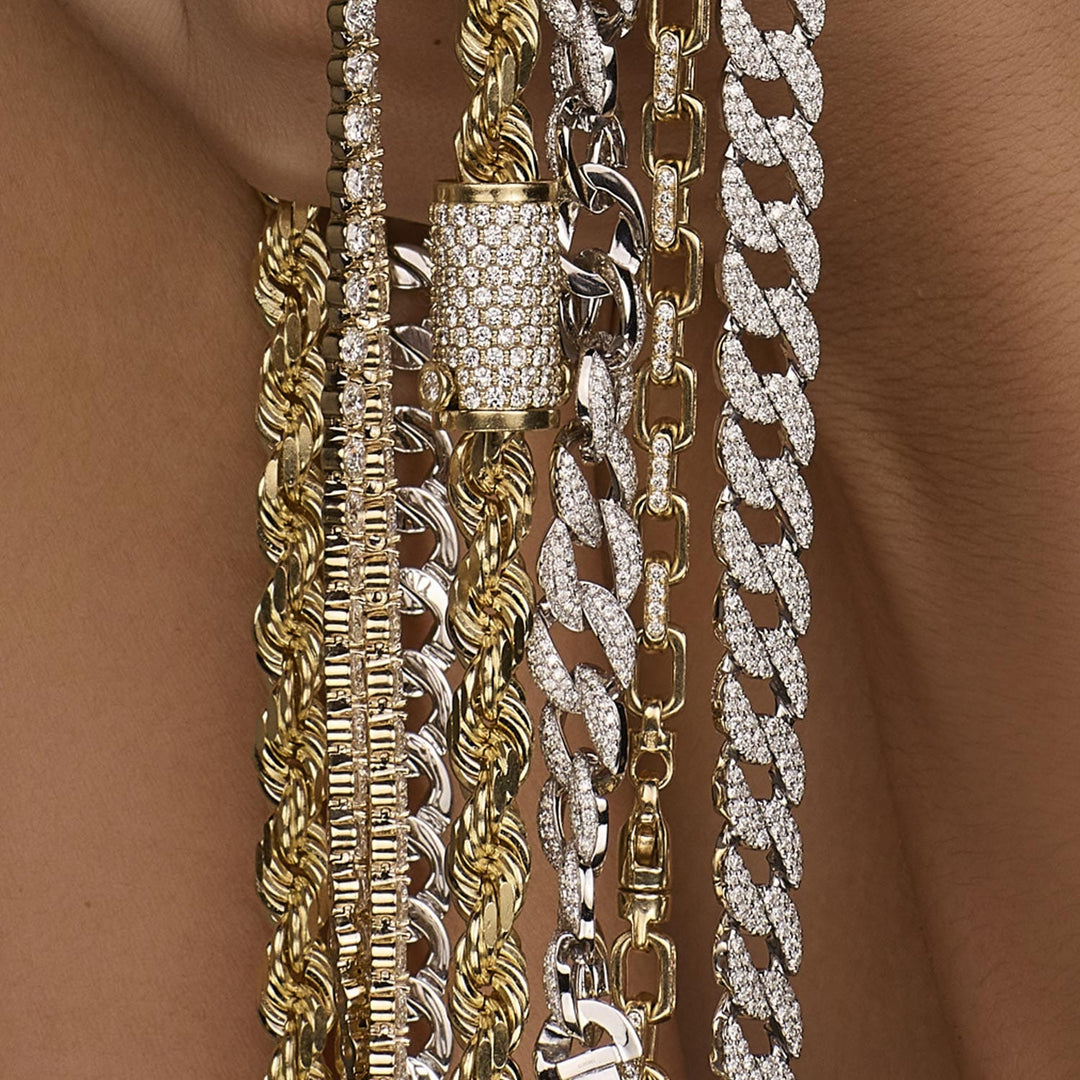
Cuban And Curb Chains
We inspect the flat surfaces and the inside of the interlocking links.
If plating is wearing, these contact points usually show it early.
Rope Chains
We look for consistent twisting and whether one section has flattened or changed color.
Figaro Chains
The repeating pattern should look even from end to end.
Box Chains
The links should look clean and consistent, without random distortion.
The style itself does not tell us whether the chain is real.
But it tells us where to look.

Should You Scratch Or File The Chain At Home?
We would not recommend it.
People sometimes scratch jewelry against ceramic, file into a link, or use acid kits at home.
The problem is that you can damage a perfectly good chain trying to test it. You can also misread the result.
If the chain is sentimental, valuable, or possibly solid gold, do not create permanent damage just to answer the question.
Bring it in and let the piece be evaluated properly.
What Do We Usually Ask You?
If you bring a chain into Nazar's & Co. Jewelers, we may ask a few simple questions.
-
Where did you get it?
-
Has it ever been repaired?
-
Do you know approximately how old it is?
-
Do you wear it often?
-
Have you noticed color changes?
That context helps.
An inherited chain with decades of wear tells a different story from a new chain purchased a few weeks ago.
Our Perspective At Nazar's & Co. Jewelers
When someone brings us a chain and asks whether it is real, we almost never make that call from one detail.
-
We turn it over.
-
We check the clasp.
-
We open the links with our fingers.
-
We look at the wear points.
-
We compare the color.
-
We feel the weight.
-
Then we test it when needed.
That is the difference between guessing and actually evaluating the piece.
At Nazar's & Co. Jewelers in Houston, we want you to understand what you have, not just hear a yes-or-no answer.
So, How Do You Spot A Fake Gold Chain?
-
Start with the details closest to everyday wear.
-
Check the hallmark.
-
Turn the chain over.
-
Look between the links.
-
Inspect the clasp.
-
See whether the gold color is wearing away.
-
Notice whether the weight makes sense for the construction.
And remember that no single home test can confirm authenticity.
If something feels inconsistent, that is usually the point where professional testing makes sense.
Bring the chain to Nazar's & Co. Jewelers in Houston, and we can help you look at the metal, construction, condition, and overall quality up close.
Sometimes the answer is visible in seconds. Sometimes it takes a closer look.
Either way, the chain usually tells you more once you know where to look.