



The Different Ways to Resize Your Wedding Ring

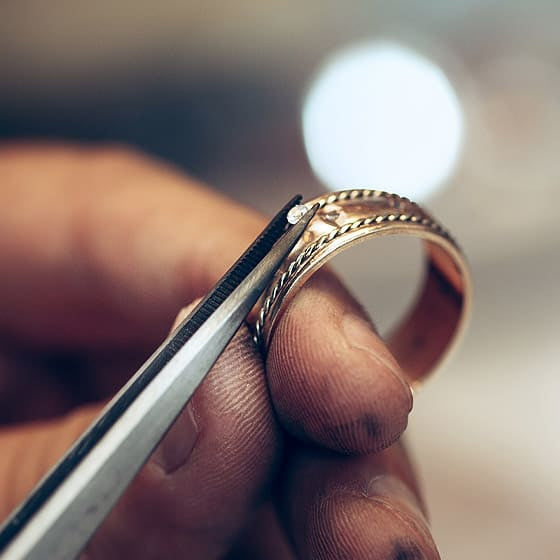
A wedding ring can be resized in several different ways. A jeweler may cut out metal to make the ring smaller, cut and add new metal to make it larger, stretch or compress a simple band, add sizing beads or an interior insert, replace part of the shank, or install a hinged shank when the knuckle creates the fit problem.
The correct method depends on the ring itself. A plain gold wedding band gives us far more options than a full eternity band with diamonds around the entire circumference.
At Nazar's & Co. Jewelers in Houston, we first determine which part of the ring can safely change without compromising the stones, engraving, shape, or strength of the band.
Method 1: Cut Out Metal to Make the Ring Smaller
This is one of the most common ways to reduce a wedding ring.
The jeweler usually works at the bottom of the shank, opposite the decorative top of the ring.
The process is straightforward:
-
Measure how much smaller the ring needs to become.
-
Mark the section of the lower shank to remove.
-
Make two precise cuts.
-
Remove the calculated piece of metal.
-
Bring the two remaining ends together.
-
Join the seam.
-
Return the ring to a true circular shape.
-
File, sand, and refinish the repair.
If the band contains engraving exactly where the cut needs to be made, the jeweler may move the cut or restore the engraving afterward.
With diamonds extending down the shoulders, the resize also needs to be followed by a setting inspection because pulling the circumference inward can slightly change the position of nearby stones.
Method 2: Cut the Ring and Add Metal to Make It Larger
For a meaningful increase in size, adding metal is generally more controlled than simply stretching the existing band.
The lower shank is cut open and the two ends are spread apart to the required circumference.
A new section of matching metal is then inserted into the gap.
That insert should match the original ring in:
-
Metal type
-
Karat
-
Color
-
Width
-
Thickness
-
Profile
If you have an 18K yellow gold band with a rounded exterior, for example, the added section needs to be shaped to continue that same curve.
The new piece is joined at both ends, then filed until those transitions disappear.
This method adds actual material rather than forcing the metal already in the ring to cover a larger circumference.
How Are the Cut Sections Rejoined?
The method of resizing and the method of joining are separate decisions.
Soldering
Traditional soldering uses a joining alloy with a lower melting temperature than the ring itself.
The jeweler aligns the seam, applies flux and solder, heats the area, and allows the solder to flow through the joint.
It is widely used for gold wedding bands.
Laser Welding
A laser concentrates heat in a much smaller area and can fuse matching metal directly into the joint.
We may prefer laser work when:
-
Diamonds sit close to the resize
-
Pavé extends down the band
-
Engraving needs to be preserved
-
Previous solder joints are nearby
-
Two different metals meet in the same ring
-
The repair requires very precise metal buildup
The goal in either case is the same: the resized portion should become a strong, integrated part of the shank rather than an obvious weak seam.
Method 3: Stretch a Plain Wedding Band
Some wedding bands can be made slightly larger without being cut.
A plain ring is placed on a stretching tool and gradually expanded.
This can work well for a small adjustment when the ring is:
-
Plain
-
Uniform in thickness
-
Free of gemstones
-
Free of continuous engraving
-
Structurally sound
But stretching has a clear limitation: you are increasing the circumference without adding metal.
Push it too far and the band can become thinner, narrower, or distorted.
We generally would not choose this method for pavé, channel-set stones, milgrain, detailed engraving, or complex profiles.
Method 4: Compress a Plain Band
The reverse approach can sometimes be used to make a simple band slightly smaller.
Instead of removing a section, specialized equipment compresses the circumference.
Again, this is mostly appropriate for a plain, uniform ring.
If the wedding band has an engraved pattern running all the way around, compression may squeeze that pattern.
If it has stones, compression can change the spacing between settings.
For those rings, cutting and rejoining usually gives the jeweler much more control.
Method 5: Add Sizing Beads
Sometimes the ring does not actually need to become smaller around its entire circumference.
This is common when your knuckle is larger than the base of your finger.
The ring needs enough room to get over the knuckle but then spins once it reaches the bottom.
A jeweler can add two small metal beads inside the lower shank.
They take up a little interior space and help stabilize the ring without permanently reducing the full circumference.
Sizing beads are especially useful for:
-
Top-heavy engagement rings
-
Small size corrections
-
Larger knuckles
-
Rings that rotate but do not fall off
Because very little of the original ring has to change, they can also be useful when exterior engraving makes a conventional resize undesirable.
Method 6: Add an Interior Sleeve or Insert
An interior sleeve provides a broader contact area than sizing beads.
A thin section of metal is fitted inside the band to reduce its internal diameter while leaving much of the exterior untouched.
This may be considered when:
-
The exterior has continuous engraving
-
The outside pattern should remain uninterrupted
-
Only a modest reduction is needed
-
The ring is difficult to resize conventionally
-
The important tradeoff is thickness.
Adding material inside the ring changes how it feels on the finger, so the interior profile needs to remain comfortable.
Method 7: Replace the Lower Shank
Sometimes cutting out a small section is not enough because the bottom of the ring is already worn too thin.
Instead, the jeweler may replace a substantial portion of the lower band.
With a half-shank replacement:
-
The worn lower section is removed.
-
A new piece of matching metal is fabricated.
-
It is fitted between the remaining sides of the ring.
-
Both joints are soldered or laser welded.
-
The new shank is shaped to the correct size.
-
The entire lower section is blended and refinished.
This solves two problems at once: size and structural wear.
Simply making a badly worn shank smaller would leave you with a correctly sized ring that is still too thin.
Method 8: Install a Hinged or Arthritic Shank
For some clients, circumference is not the real problem.
The ring fits properly at the base of the finger but cannot comfortably pass over an enlarged knuckle.
A hinged shank changes the mechanics completely.
Part of the band opens, allowing a larger opening to pass over the knuckle. It then closes around the narrower part of the finger.
This can be particularly useful when arthritis, injury, or permanent knuckle enlargement makes ordinary sizing ineffective.
It is a more substantial modification, but sometimes it is the only method that solves both access over the knuckle and correct fit afterward.
What About Rings With Diamonds All the Way Around?
Full eternity bands are among the most difficult rings to resize because there is no plain section of shank available.
Traditional resizing may require:
-
Removing one or more stones
-
Cutting through the setting
-
Adding or removing an entire stone position
-
Rebuilding shared prongs or channel walls
-
Resetting the stones
For a significant size change, remaking the ring may produce a cleaner and stronger result.
That is fundamentally different from resizing a plain band.
Which Resizing Method Fits Which Ring?
|
Ring Situation |
Common Approach |
|
Plain band, needs to be smaller |
Cut, remove metal, rejoin |
|
Plain or stone-set ring, needs to be larger |
Cut, add matching metal, rejoin |
|
Plain band, very small increase |
Stretching may be possible |
|
Plain band, very small reduction |
Compression may be possible |
|
Ring spins below a large knuckle |
Sizing beads |
|
Exterior should remain untouched |
Interior sleeve may be considered |
|
Lower shank is badly worn |
Half-shank replacement |
|
Large or arthritic knuckle |
Hinged shank |
|
Full eternity band |
Structural alteration or remake |
The Nazar's & Co. Jewelers Perspective
At Nazar's & Co. Jewelers, we do not think of resizing as one repair with different measurements.
There are several completely different ways to solve a fit problem.
-
Sometimes we remove metal.
-
Sometimes we add it.
-
Sometimes we do not cut the ring at all.
-
Sometimes the correct repair is to replace half the shank.
And sometimes the problem is the knuckle rather than the ring size, which calls for an entirely different mechanism.
The important part is choosing the method that changes only what needs to change while preserving the structure, stones, engraving, and character of the wedding ring.