

What Causes the Bow-Tie Effect in Oval Diamonds?

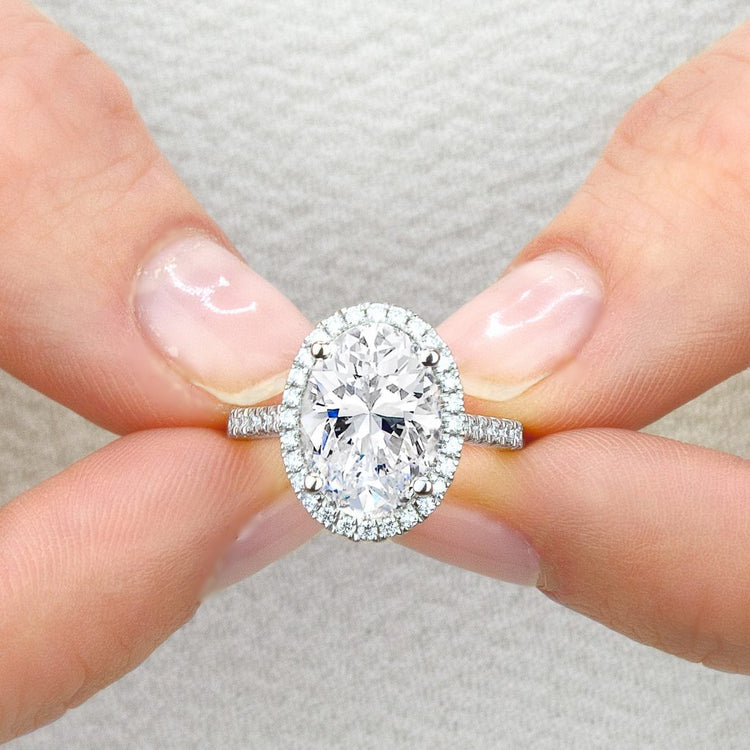
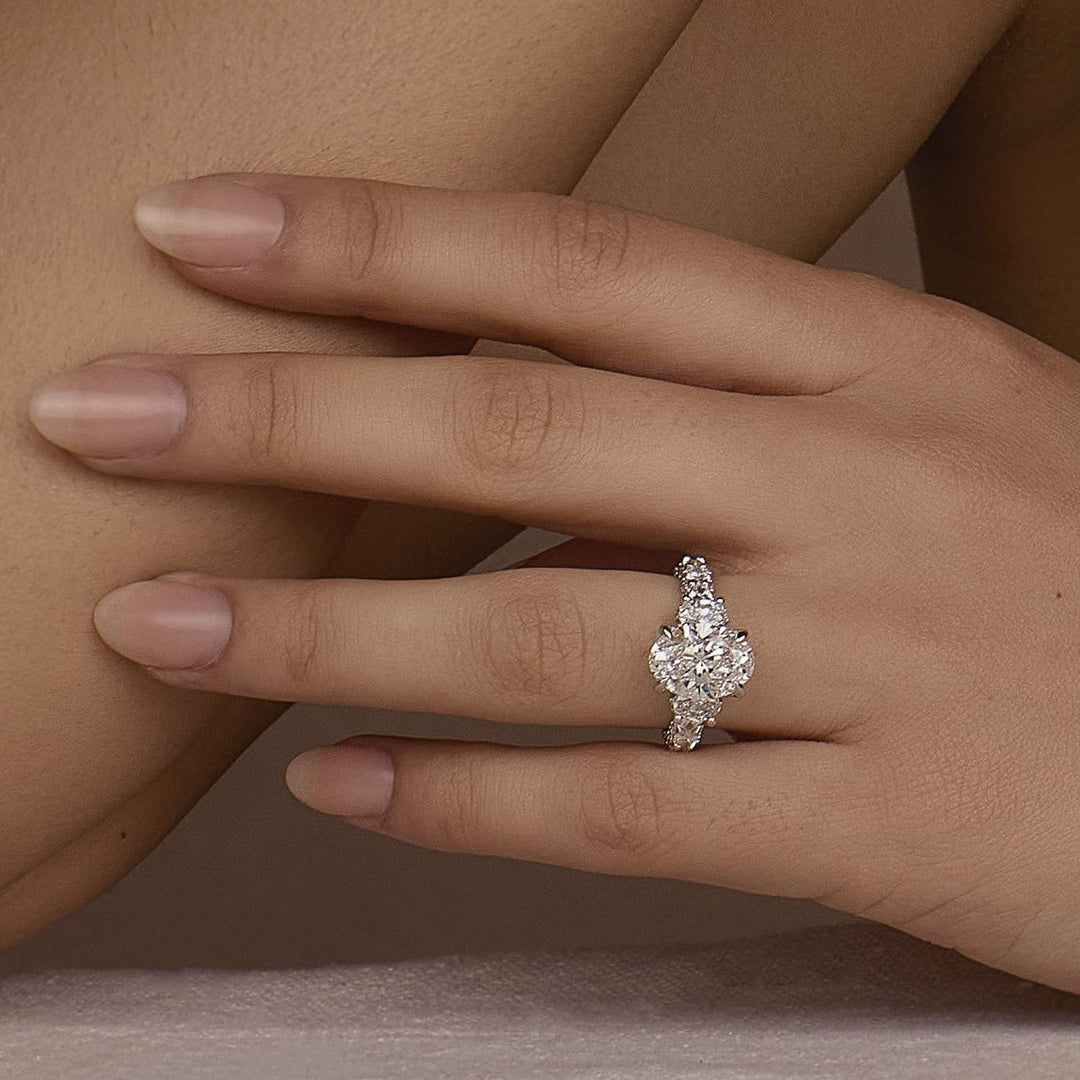
The bow-tie effect in an oval diamond is the dark or shadowed band that can appear across the center of the stone. It happens because of how an oval’s elongated brilliant-cut facets return light to your eye. Some central facets may reflect less light, reflect your head or surroundings, or create stronger contrast than the rest of the diamond.
A slight bow-tie is common in oval diamonds and is not automatically a defect.
The real question is how strong, dark, and persistent it looks in normal movement.
At Nazar's & Co. Jewelers in Houston, we compare oval diamonds face-up, tilt them, move them under different light, and look at how the center behaves before deciding whether the bow-tie adds useful contrast or becomes distracting.
What Is Actually Creating the Dark Bow-Tie?
An oval diamond does not return light evenly across its entire surface.
Its long shape means the facet angles at the center interact with light differently from the facets toward the rounded ends.
Across the middle of the oval, some facets can act like small mirrors.
Instead of returning bright overhead light, they may reflect:
-
Your head
-
Your body
-
The camera
-
A darker part of the room
-
Less direct light
That reflection creates the familiar horizontal “bow-tie” shape.
So the bow-tie is not simply a dark patch inside the diamond.
It is a light-return and contrast pattern created by the geometry of the cut.
Why Do Some Oval Diamonds Have Stronger Bow-Ties Than Others?
The strength of the bow-tie depends on how the entire facet structure works together.
Several factors matter.
Pavilion Angles
The pavilion is the lower portion of the diamond.
If its facets direct too much light away from your eye, the center may appear darker.
Small differences in pavilion angles can create a noticeably different face-up appearance even between two ovals of similar size.
Crown Angles
The crown facets help determine how light enters, exits, and breaks into brightness and fire.
Their relationship with the pavilion affects whether the center looks lively or flat.
Facet Alignment
An oval is not just a round brilliant stretched longer.
Its facets have to be arranged around an elongated outline.
If the central facets interact poorly, the bow-tie can become broad and dark.
Overall Proportions
Depth, table size, outline, and length-to-width ratio all influence the optical pattern.
But no single measurement tells you whether the bow-tie will be attractive.
Two diamonds with nearly identical proportions can still look very different.
Is the Bow-Tie Caused by Light Leakage?
Sometimes partially, but not always.
This distinction matters.
Light leakage means light enters the diamond but exits in a direction where it does not return to your eye.
Obstruction occurs when facets reflect something blocking the incoming light—often the observer.
A dark central area may involve one, the other, or a combination of both.
That is why a bow-tie should not be judged only by asking, “Is this area dark?”
We also ask:
Does it brighten when the diamond moves?
A dark band that breaks into flashes as you tilt the stone is very different from a broad black area that remains dark from many viewing angles.
Does a Longer Oval Have a Stronger Bow-Tie?
Not necessarily.
Length-to-width ratio changes the outline, but it does not determine bow-tie intensity by itself.
A longer oval can have an attractive, lively center.
A rounder oval can still show a strong bow-tie.
Typical preferences often fall somewhere around a balanced elongated shape, but the optical result depends on the cut, not simply the ratio.
What We Look at Instead
We compare:
-
Width of the dark band
-
Darkness of the center
-
How quickly it changes with movement
-
Brightness around the bow-tie
-
Symmetry from left to right
-
Whether the bow-tie dominates the diamond
-
The outline tells us the shape.
The light performance tells us whether that particular oval works.
Can the Grading Report Tell You if an Oval Has a Bow-Tie?
Not reliably.
A grading report gives useful information such as:
-
Carat weight
-
Measurements
-
Color
-
Clarity
-
Table
-
Depth
-
Polish
-
Symmetry
Those numbers help us screen stones.
But they do not fully describe the bow-tie.
An oval can have attractive measurements and still show a heavy dark center.
Another may have less “ideal-looking” numbers yet appear much brighter in person.
This is one reason oval diamonds should be evaluated visually rather than purchased from proportions alone.
What Does a Good Bow-Tie Look Like?
A good oval does not necessarily have zero contrast.
Contrast is part of what gives a diamond pattern and movement.
A subtle bow-tie can actually help the center look more dimensional.
The problem begins when the dark area becomes the first thing you notice.
|
Bow-Tie Appearance |
What It Usually Means Visually |
|
Light, narrow contrast |
Often normal and unobtrusive |
|
Visible but changes with movement |
Usually worth comparing in person |
|
Broad, dark center |
Can dominate the diamond |
|
Uneven left-to-right pattern |
May indicate less balanced facet behavior |
|
Dark band that remains persistent |
More likely to be distracting |
The goal is not necessarily to eliminate the bow-tie.
It is to make sure it does not overpower the rest of the stone.
Why Movement Matters More Than a Single Photo
A still image can exaggerate or hide a bow-tie.
The photographer, camera, lighting position, and background all affect what the diamond reflects.
That is why we prefer to move the stone.
Tilt it slightly forward.
Rotate it left and right.
Move it away from direct jewelry-store lighting.
A well-cut oval should produce changing flashes across the center rather than leaving one large dark area fixed in place.
What Looks Different in Person
This is where many preferences change.
A bow-tie that looks dramatic in a static photo may almost disappear in motion.
The opposite can also happen.
A diamond photographed from its best angle may reveal a much heavier central shadow once you rotate it.
That is why video helps, but physical comparison is better.
Can the Setting Hide a Bow-Tie?
Not really.
A setting can change the overall appearance of the diamond, but it cannot correct poor light behavior inside the stone.
Yellow gold may change the visual contrast around the diamond.
A halo can make the center stone appear larger.
A bezel changes the outline and amount of visible metal.
But none of these changes the internal facet geometry that created the bow-tie.
If the dark band bothers you while the diamond is loose, do not assume the setting will solve it.
Does a Bow-Tie Make an Oval Diamond Less Valuable?
Only when it materially affects appearance and desirability.
A mild bow-tie is common and may have little practical effect on value.
A strong, dark, persistent bow-tie can make an otherwise attractive oval less desirable because the center appears less lively.
That is why two ovals with similar carat, color, and clarity can still command different prices.
The grading categories may look similar.
The face-up beauty may not.
The Nazar's & Co. Jewelers Perspective
At Nazar's & Co. Jewelers, we do not reject an oval simply because we can see a bow-tie.
We reject it when the bow-tie becomes more noticeable than the diamond itself.
A strong oval should give you brightness, shape, contrast, and movement across the whole stone.
The center should participate in that performance, not sit there as a dark stripe.
When comparing oval diamonds in person, focus less on whether a bow-tie exists and more on how it behaves as the diamond moves.
That is where the difference between a normal optical pattern and a distracting one becomes clear.